Position and Distance
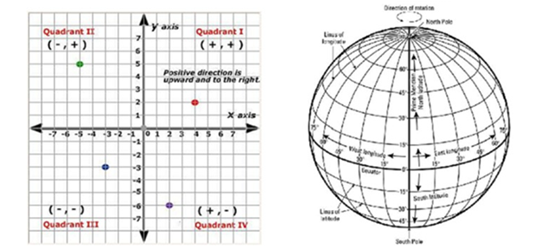
Frame of reference is a concept used for determining the position of a point or object in space. Any frame of reference comprises of at least two axes: the horizontal, vertical. The concept is used in Physics, Mathematics, Geography, etc.
In Physics and Mathematics, the frame of reference is called the Cartesian plane which comprises basically two axes: x and y axes. As shown below:
The horizontal (x) axes increases to the right and the vertical (y) axes increases upwards. This cartesian frame is also applied in computer graphics, for example: CorelDRAW, to show the printable area in the workspace/drawing area.
In Geography, the frame of reference is the 0o latitude (equator) and the 0o longitude (meridian). Every position on the earth surface is represented as a combination of latidude and longitude from the equator and meridian respectively.
Let's consider the cartesian below:
The point A is the intersection of where x = 3 and y = 4, thus, we represent the point A as (3,4).
The point B is the intersection of where x = 6 and y = 10, thus, we represent the point B as (6, 10).
The point C is the intersection of where x = 18 and y = 6, thus, we respresent the point C as (18, 6).
Let's consider the map:
The point A is the intersection of latitude = 5oN and longitude = 7oE, thus, we represent the point A as 5oN, 7oE.
The point B is the intersection of latitude = 4.5oN = 4o30'N and longitude = 7oE, thus we represent the point B as 4o30'N, 7oE.
The point C is the intersection of latitdue = 4.5oN = 4o30'N and longitude = 7.5oE = 7o30'E, thus, we represent point C as 4o30'N, 7o30'E.
Distance is the space between two points. This could be on a flat surface or a spherical surface.
For flat surfaces, the formula is:
For spherical surfaces, the formula is:
Q1. Find the distance between points A (3, 10) and B (5, 9).
Solving ;
;
Q2. Find the distance between Towns A (3oN, 10oE) and B (5oN, 9oE) on a sphere.
Solving
- The position of an object is determined with respect to the frame of reference.
- The position of an object on a flat surface is represented based on the x and y axes as (x, y).
- The position of an object on spherical surace is represented based on the latitudes and longitudes e.g. (N, E), (S,E).
- Distance is the space between two positions or points.
- To calculate distances on a flat surface, we use:
- To calculate distances on a spherical surface (e.g. the earth), we use: