Lines and Angles
A line is a fundamental element that connects two points. Conceptually, it can be described as a path traveling from one point to another; this path may be straight or curved.
Lines are used to visualize equations, illustrating the mathematical relationship between different parameters or variables. They are also used to represent distance and displacement. Lines, with arrows, are used to represent direction and flow. They are used to create architectural plans, engineering blueprints, and geographical maps.
Lines could either be curved or straight. Straight maintain a direction. They could be horizontal, vertical, diagonal.
When lines lie on the same plane and they have the same direction but different set of coordinates or positions, they are considered to be parallel lines. Since they face the exact same direction, they would never cross each other. Lines that cross each other are called transversal lines. If the angle created at the point of their intersection is $90^{\circ}$, they are called perpendicular lines. Essentially, all perpendicular lines are transversal lines but not all transversal lines are perpendicular to each other.
Curved lines change direction in a smooth pattern, thus they are bent. A curved line is a part or combination of part(s) of an elliptic or circular path.
To draw a line, you would have to mark the points where the line is to run through. If the marked points suggest a straight line, you can then use a ruler to draw the line that would join the marked points. If the marked points suggest a curved line, you can use a French curve or a flexible ruler to draw the curved line that would join the marked points.
To measure a straight line, you use a straight ruler. The start of the line must match with the zero mark on the ruler. You can then read the point on the ruler that matches the end of the line. If the line is a curved line, you would have to use a string to match the entire line finely. Thereafter, you can use a straight ruler to measure the length string.
 | 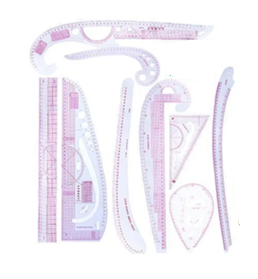 | 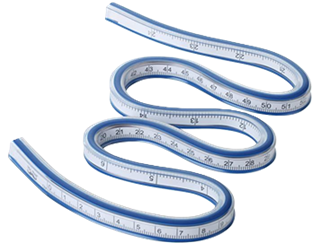 |
| Ruler | French Curves Set | Flexible Ruler |
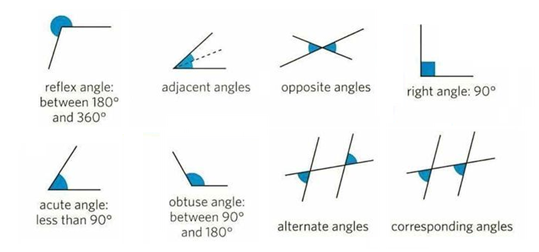
Angles are the measure of direction or inclination. Essentially, an angle is what forms between two lines that have the same origin. Angles are measured in degrees ($^{\circ}$) or radians ($rads$). Just as there are $360^{\circ}$ in a circle, so also there are $\approx6rads$ in a circle. When it comes to direction or inclination, we prefer to use degrees but when it comes to distance travelled by the angle, radians is the preference. Angles are denoted by $\angle$ or , for example: $\angle A$ or $\hat{A}$.
Angles are generally classified based on how they interact with the quadrantal angles: $90^o$, $180^o$, $270^{\circ}$, $360^{\circ}$, and how they relate with other angles formed at points of intersection or transversal.
- Acute Angle. These are angles that form in the first quadrant, that is they are less than $90^{\circ}$. $$0^{\circ} < \theta < 90^{\circ} \implies \theta \in \text{Acute angle}$$
- Right Angle. A right angle is an angle that equals $90^{\circ}$. Lines at right angles are said to be perpendicular. The symbol for right angle is . $$\theta = 90^{\circ} \implies \theta \text{ is a right angle}$$
- Obtuse Angle. An obtuse angle is an angle that is greater than $90^{\circ}$ but less than $180^{\circ}$. Essentially, they occur in the second quadrant. $$90^{\circ} < \theta < 180^{\circ} \implies \theta \in \text{Obtuse angle}$$
- Straight Line Angle. A straight line angle is an angle that equals $180^{\circ}$. $$\theta = 180^{\circ} \implies \theta \text{ is a straight line angle}$$
- Reflex Angle. A reflex angle is an angle that is greater than $180^{\circ}$ but less than $360^{\circ}$. Essentially, they occur through the third and fourth quadrants. $$180^{\circ} < \theta < 360^{\circ} \implies \theta \in \text{Reflex angle}$$
- Oblique Angle. An oblique angle is an angle that is not $90^{\circ}$. The oblique angle is used to describe shapes that are do not stand straight but are somewhat bent from the top to the base.$$\theta \ne 90^{\circ} \implies \theta \in \text{Oblique angle}$$
When angles relate with other angles at points of intersection, they result into the following:
- Complementary Angles. This is any pair of angles whose sum equals $90^{\circ}$.$$a+b = 90^{\circ} \implies a \text{ and } b \text{ are complementary angles }$$
- Supplementary Angles. This is any pair of angles whose sum equals $180^{\circ}$. Supplementary angles are together considered lines on a straight line, but if the angles on a straight line are not a pair then they are non-supplementary, even though their sum equals $180^{\circ}$. $$a+b = 180^{\circ} \implies a \text{ and } b \text{ are supplementary angles}$$
- Alternate Angles. Angles on the alternating or opposite sides of transversal lines are called alternate angles. They are equal. $$ b = p \text{ (alternate angles)}$$ $$ a = q \text{ (alternate angles)} $$
- Corresponding Angles. Angles on the same corner of intersection between a transversal line and a number of parallel lines are called corresponding lines. They are equal.$$ a = c \text{ (corresponding angles)}$$ $$ b = d \text{ (corresponding angles)}$$
- Point Angles. Angles around a point can be called point angles. Their sums equals $360^{\circ}$. $$a + b + p + q + z = 360^{\circ} \text{ (angles at a point)}$$
To draw an angle, you use a protractor and a straight rule. First, draw a straight line so that the protractor's center and baseline can be well aligned and visible. Next, mark a center on the drawn line. Then, place the protractor on the line such that the center and baseline of the protractor match the marked center and baseline of the drawn line. After that, mark the point of the protractor that matches the given angle. Finally, remove the protractor and draw a line to join the marked angle point to the marked center of the drawn line.
To measure a given angle, you would still have to use a protractor. First, extend the lines of the drawn angles if they are not long enough to accommodate your protractor. Next, place your protractor such that its center and baseline match the center and baseline of the given angle. Finally, read the point, from the 0°, where the other line matches the protractor. That is the measure of the given angle.
 |
| A protractor |
- A line is an element that connect two points. It could be straight or curved.
- Straight lines could be vertical, horizontal or diagonal.
- Parallel lines are lines that have same direction and can never meet, while transversal lines are lines that travel different directions and would meet.
- To draw a straight line, you use a straight ruler, but to draw a curved line, you use a French curve or flexible ruler.
- To measure a straight line, you use a straight ruler, but to measure a curve line, you use a string to match the path and then use a straight ruler. You could also use a flexible ruler.
- Angle is the measure of direction or inclination created by lines that meet.
- Acute angles are less than $90^{\circ}$, right angle equals $90^{\circ}$, obtuse angles are greater than $90^{\circ}$ but less than $180^{\circ}$, straight line angle equals $180^{\circ}$, reflex angles are greater than $180^{\circ}$ but less than $360^{\circ}$, and oblique angles are angles not equal to $90^{\circ}$.
- Complementary angles is a pair of angles that sum up to $90^{\circ}$.
- Supplementary angles is a pair of angles that sum up to $180^{\circ}$.
- Alternate angles are angles that exist on opposites sides of an intersection, while corresponding angles are angles that exist on similar sides of an intersection across parallel lines.
- Alternate angles are equal. Also, corresponding angles are equal.
- The sum of angles around a point equals 360^{\circ}.
- To draw or measure angle, you use a protractor.