Basic Trigonometry

bannerimg

Outline
Understanding Trigonometry

Trigonometry is the aspect of mathematics that uses the concept of a triangle in a circular quadrant to describe direction, elevation/depression, and wave forms. This makes the math of trigonometry the language for surveyors, sailors, pilots, astronauts, structural engineers, and wave technology engineers.

Right Angle Triangle and the Trigonometric Ratios

Consider the figure:

y x r θ

We have a right angle triangle with sides: $r$, $y$, and $x$. The basic trigonometric ratios are $\sin\theta$, $\cos\theta$, and $\tan\theta$.

$$\sin\theta = \frac{y}{r}; \cos\theta = \frac{x}{r}; \tan\theta= \frac{y}{x}$$

$r$ represents the radius of circle. It is also called hypotenuse (the side opposite the right angle). We can also represent this side with $hyp$.
$y$ represents the vertical displacement. It is the opposite side to the $\angle\theta$. We can also represent this side with $opp$.
$x$ represents the horizontal displacement. It is the adjacent side to the $\angle\theta$. We can also represent this side with $adj$.

$$\sin\theta = \frac{opp}{hyp}; \cos\theta = \frac{adj}{hyp}; \tan\theta= \frac{opp}{adj}$$

For easy remembrance, you use the acronym: SOH-CAH-TOA

Right Angles in Quadrants of a Circle

In bearings, we read direction/angle either through the Azimuth method or the Qradrantal method. While in Azimuth, we start at $0^o$ (which is same as $N0^o$) and then read clockwise, in quadrantal method, we start either $N0^o$ or $S0^o$ and read towards the $E$ or $W$ direction. Similar phenomenon applies with basic trigonometry, but this time angles are read anti-clockwise. If read clockwise, the angles would be represented in the negative.

Consider the Cartesian plane:

+x+y-x-yO

Angles are read from the $+x$ axis anticlockwise. Essentially, by theory, the circle starts at $+x$ as $0^o$ and travels anticlockwise through the circle.

27 0 o O 180 o 0 o 90 o

Now let's put our right angle triangle at the center of a circle, wherein the side $r$ equals the radius of the circle (with center $O$):

r y x r θ O
Also, let's mark the cartesian plane inside the circle.
27 0 o O 180 o 0 o 90 o r + y + x θ = Φ
You now find that the circle is now divided into four (4) parts called quadrants. The first quadrant spans $0^o$ through $90^o$. The second spans $90^o$ through $180^o$.
27 0 o O 180 o 0 o 90 o - x θ r + yΦ
The third spans $180^o$ through $270^o$.
27 0 o O 180 o 0 o 90 o - x θ r -y Φ
The fourth spans $270^o$ through $360^o$.
27 0 o 180 o 0 o 90 o x + θ r - y Φ

Trigonometric Ratios in Quadrants of a Circle

In the first quadrant, $\Phi \le 90^o \implies \Phi = \theta$

$$\sin\theta=\frac{y}{r}; \cos\theta=\frac{x}{r}; \tan\theta=\frac{y}{x}$$
$$\sin\theta; \cos\theta; \tan\theta$$
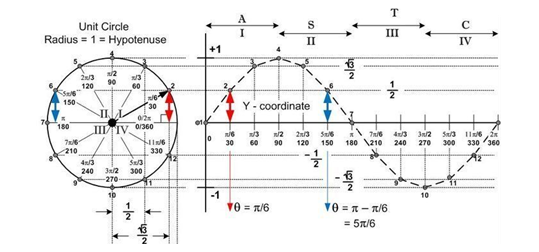
ALL trigonometric ratios are positive in the first quadrant.

In the second quadrant, $180^o > \Phi > 90^o \implies \theta = 180^o - \Phi$

$$\sin\theta=\frac{y}{r}; \cos\theta=\frac{-x}{r}; \tan\theta=\frac{y}{-x}$$
$$\sin\theta; -\cos\theta; -\tan\theta$$
SINE only is positive in the second quadrant.

In the third quadrant, $270^o > \Phi > 180^o \implies \theta = \Phi - 180^o$

$$\sin\theta=\frac{-y}{r}; \cos\theta=\frac{-x}{r}; \tan\theta=\frac{-y}{-x}=\frac{y}{x}$$
$$-\sin\theta; -\cos\theta; \tan\theta$$
TANGENT only is positive in the third quadrant.

In the fourth quadrant, $360^o > \Phi > 270^o \implies \theta = 360^o - \Phi$

$$\sin\theta=\frac{-y}{r}; \cos\theta=\frac{x}{r}; \tan\theta=\frac{-y}{x}$$
$$-\sin\theta; \cos\theta; -\tan\theta$$
COSINE only is positive in the fourth quadrant.

For easy remembrance of which is trigonometric ratio is positive in each quadrant starting at the fourth quadrant, the acronym CAST can serve as hint.

C A T S

Other Trigonometric Identities

Other trigonometric identities/equations are:

Cofunction Identities:
$$\sin\theta = \cos(90-\theta)$$
$$\cos\theta = \sin(90-\theta)$$
Reciprocal Identities:
$$\csc\theta=\frac{1}{\sin\theta}; \sec\theta = \frac{1}{\cos\theta}; \cot\theta = \frac{1}{\tan\theta}$$
$$\tan\theta = \frac{\sin\theta}{\cos\theta}; \cot\theta = \frac{\cos\theta}{\sin\theta}; $$
Pythagorean Identities:
$$\sin^2\theta + \cos^2\theta = 1$$
$$\tan^2\theta + 1 = \sec^2\theta$$
$$1 + \cot^2\theta = \csc^2\theta$$
Sum and Difference Identities:
$$\sin(\theta \pm \phi) = \sin\theta \cos\phi \pm \cos\theta \sin\phi$$
$$\cos(\theta \pm \phi) = \cos\theta \cos\phi \mp \sin\theta \sin\phi$$
$$\tan(\theta \pm \phi)=\frac{\sin(\theta \pm \phi)}{\cos(\theta \pm \phi)} = \frac{\tan\theta \pm \tan\phi}{1\mp\tan\theta\tan\phi}$$
Multiple-Angle Identities:
$$\sin2\theta = 2\sin\theta\cos\theta$$
$$\cos2\theta = \cos^2\theta-\sin^2\theta=2\cos^2\theta-1=1-2\sin^2\theta$$
$$\tan2\theta = \frac{2\tan\theta}{1-\tan^2\theta} $$
$$\cos3\theta = 4\cos^3\theta - 3\cos\theta$$
$$\sin3\theta = 3\sin\theta - 4\sin^3\theta$$
$$\tan3\theta = \frac{3\tan\theta - \tan^3\theta}{1-3\tan^3\theta}$$
Submultiple-Angle Identities:
$$sin^2 \frac{1}{2}\theta = \frac{1}{2}(1 - \cos \theta)$$
$$\cos^2 \frac{1}{2}\theta = \frac{1}{2}(1 + \cos \theta)$$
$$\tan^2 \frac{1}{2}\theta = 1 - 2 \cot \theta \tan \frac{1}{2}\theta$$
Power-Reduction Identities:
$$\sin^2 \theta = \frac{1 - \cos(2\theta)}{2}$$
$$\cos^2 \theta = \frac{1 + \cos(2\theta)}{2}$$
$$\tan^2 \theta = \frac{1 - \cos(2\theta)}{1 + \cos(2\theta)}$$
Sine and Cosine Product Identities:
$$\sin A \cos B = \frac{1}{2}[\sin(A + B) + \sin(A - B)]$$
$$\cos A \cos B = \frac{1}{2}[\cos(A + B) + \cos(A - B)]$$
$$\sin A \sin B = \frac{1}{2}[\cos(A - B) - \cos(A + B)]$$
Half Angle Identities:
$$\sin(\frac{\theta}{2})=\pm\sqrt{\frac{1-\cos\theta}{2}}$$
$$\cos(\frac{\theta}{2})=\pm\sqrt{\frac{1+\cos\theta}{2}}$$
$$\tan(\frac{\theta}{2})=\frac{1-\cos\theta}{\sin\theta}=\frac{\sin\theta}{1+\cos\theta}$$

Summary
  • Trigonometry is the aspect of mathematics that uses the concept of a right angle triangle in a circle to describe direction, elevation/depression, and wave forms.
  • SOH CAH TOA is an acronym for the trigonometric ratios: $$\sin\theta =\frac{opp}{hyp};\cos\theta =\frac{adj}{hyp}; \tan\theta =\frac{opp}{adj}$$
  • Angles are read from the $+x$ axis as $0^o$ and then anticlockwise.
  • CAST is an acronym for determining the positive trigonometric ratio in each quadrant of a circle. $\cos\theta$ is positive in the fourth quadrant, all are positive in the first quadrant, $\sin\theta$ is positive in the second quadrant, and $\tan\theta$ is positive in the third quadrant.