Ear Training and Tonic Solfa
Ear training is the skill of being able to hear parts or the whole of a piece of music and then play and/or transcribe it. Essentially, a person who is well-trained in this skill would be able to hear music and replicate or transcribe the same or a similar sound.
Ear training for rhythm and melody is similar, but the focus differs slightly. For rhythm, the focus is on beat timing and timbre; for melody, the focus is on tonality (i.e., the tonic solfa) of the music.
To practice ear training, you will need a simple music player (such as a phone) with headphones or earphones for better listening, along with a simple musical instrument (such as a recorder or a harmonica).
Ensure you are already familiar with the fingerings for your chosen instrument. Essentially, you should be able to play a basic major scale (do-re-mi) on it. (Tap here to find the fingering chart for the recorder).
Listen to simple pieces of music and try to identify the tonality. Over time, you will be able to navigate the instrument?? fingerings to match the music you hear. With enough practice, you will be able to play along more accurately and promptly, and eventually, you may even be able to transcribe the music.
Tonic Solfa is kind of musical notation wherein notes are named based on their tonality difference to the first note (called movable $Do$) of the musical piece. This contrast with the absolute musical notation wherein each note has an absolute position on the clef-staff. It was invented by Sarah Ann Glover (1785-1867) of Norwich, England and popularised by John Curwen who adapted it from a number of earlier musical systems.
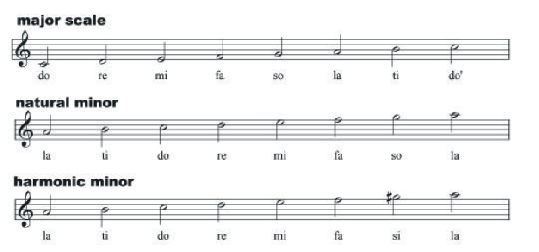
It uses a system of musical notation based on movable $Do$ solf?ge, whereby every tone is given a name according to its relationship with other tone in the key. The usual staff notation is replaced with anglicize solf?ge syllables (e.g. do, re, mi, fa, so, la, ti, do') or their abbreviations:
d, r, m, f, s, l, t, d'
For notes above the principal octave, an apostrophe follows the letter. Notes below the principal octave have a subscript mark. Chromatic alterations are marked by the following vowel, "e" for sharp (pronounced "ee") and "a" for flat (pronounced "aw"). Thus, the ascending and descending chromatic scale is noted:
d de r re m f fe s se l le t d'
d' t ta l la s sa f m ma r ra d
The tonic solfa notation is the best for ear training and learning musical notation as it adjusts to whatever ever scale a music is played in.
Here are three (3) common musical pieces for basic practice.
Twinkle Twinkle Little Star
d d s s l l s
[Twinkle Twinkle Little Star]
f f m m r r d
[How I wonder what you are]]
s s f f m m r
[Up above the world so high]
s s f f m m r
[Like a diamond in the sky]
d d s s l l s
[Twinkle Twinkle Little Star]
f f m m r r d
[How I wonder what you are]
One Love
m m  r r m f
One love, one heart
f m r d r d m r d
Let's get together and feel alright

m s s m s m (m m)
Hear the children crying (One love)
l s s m s m r (r r)
Hear the children crying (One Heart)

m s m f f  f m r d
Saying, give thanks and praise to the Lord
d d r m r d
and I will feel alright
f m r d r d m r d
Let's get together and feel alright

m r d l
wo,wo,wo,wo

m f m m r d d d s m (d s)
Let them all pass all their dirty remarks (One love)
m f m m r d m r d r d (d s)
There is one question I'd really love to ask (One heart)
m f m r l l d d r m
Is there a place for the hopeless sinner
d d m s l m d d r t d
Who has hurt all man-kind just to save his own?

m m  r r m f
One love, one heart
f m r d r d m r d
Let's get together and feel alright

m f m m r d d d d d d d l s (d s)
Let's get together to fight this Holy Armageddon (One love)
l m f m d s l d m r d (d s)
So when the man comes there will be no-no doom (One song)
l d m m m r l l l d r m
Have pity on those whose chances grow thinner
m s l s f m r s s l d r m r d
There ain't no hidding place from the father of creation

m m  r r m f
One love, one heart
f m r d r d m r d
Let's get together and feel alright
Common Person
r m m r m r r r
[Na me wey dey clean una house]
r m m r m l l d
[Na me wey dey wash una car]
d r r d r d d d
[Na me wey dey cook ununu]

r m m r m d r
[Na me wey dey wash una cloth]
r m m r m l l d
[Na me wey dey work for your shop]
d r r d r d d d
[Na me wey dey hawk ununu]

m s l s s r d r m d d l r d r m
[I be common person, but my happiness, oh, still be my own]
m s l s s r d r m d d l r d r m
[Everybody get role, no mean say your own role pass??my own]

d d r m r m d m d r
[Because na God I dey put all my faith]
d r d r r r d d (r r d d)
[food for my plate fit no do me chop (Mm, balanso)]
m m f s d r m r d r
[Even as things no dey go my way]
r r m d r m r d d (r r d d )
[Even the days I no get nothing at all (Mm, balanso)]

m m f s m r
[Na me wey dey drive your bus]
r r m l l d ( r r d d)
[Na me wey drive your keke (Mm, balanso)]
s d t l f s
[Na me wey dey run around]
s l s m r d m r d :r (r r d d )
[Na me dey do the job (mm,balanso)]

m s l s s r d r m d d l r d r m
[I be common person, but my happiness, oh, still be my own]
m s l s s r d r m d d l r d r m
[Everybody get role, no mean say your own role pass??my own]
- Ear training is the skill of being able to hear a music and being able to play or transcribe it.
- To practice ear training, you need a music player with a headphone or earpiece and a simple musical instrument.
- Tonic Solfa is the kind of musical notation based on the tonality of musical notes in a musical piece. It is very useful when learning ear training.
- Tonic solfa uses anglicize solfege syllables: do, re, mi, fa, so, la, ti, do' or their abbreviations (d, r, m, f, s, l, t, d'.
- Notes above the base octave are followed with apostrophes (e.g. d', r'), while notes below the base octave are followed with subscripts (e.g. ,, r,).
- For sharp notes, the solfa notes are ended in 'e'. For example, r# is re. For flat notes, the solfa notes are ended in 'a'. For example, r♭ is ra.