The British Empire 1914 to Date
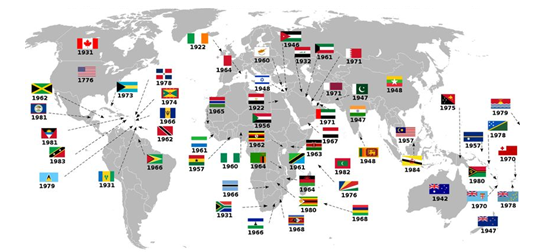
The British Empire is the term that describes the collective annexation of overseas territories by Great Britain. The term Great Britain has been used by convention since 1474 to refer to the island—contrasting it with "Lesser Britain" (Brittany)—it was formally adopted to name the unification of the Kingdoms of England and Scotland following the Acts of Union in 1707. It is also noteworthy that the term used to name the empire is not the "United Kingdom Empire" because the term United Kingdom was originally Great Britain and Ireland as a colony, before the Act of Union 1800 unified the Kingdom of Great Britain and the Kingdom of Ireland in 1801.
The concept of the British Empire is clearly illustrated by the history of Ireland, which was invaded in 1169 and subsequently annexed as a colony of Great Britain. Even though the Acts of Union legally incorporated Ireland into the United Kingdom, the nation continued to seek independence due to political, economic, and social subjugation, finally achieving it through the Anglo-Irish Treaty of 1922. In the same manner that Ireland was invaded and annexed, numerous other lands were similarly colonized by the British. Just as Ireland pursued sovereignty in response to its subjugation, these annexed territories also sought independence for the similar reason through various means.
From 1914 to the present day, many colonies of the British Empire have gained their independence. This shift occurred due to the economic devastation caused by the two World Wars, rising local nationalism within the colonies, and a global movement against colonialism, as evidenced by the UN Declaration on the Granting of Independence to Colonial Countries and Peoples.
In 1914, the British Empire was already over 700 years old, dating back to the invasion and occupation of Ireland. At this time, Europe was destabilized by an increasing scramble for territorial lands, where the slightest provocation could lead to war. Under the spirit of "The Sun Never Sets," Great Britain continued planning imperial expansions until August 1914. Prior to that month, the assassination of Archduke Franz Ferdinand, heir to the Austro-Hungarian throne, had led to speculations of war against Serbia by the German-backed Austro-Hungarian Empire. By August, the conflict had begun, with Germany violating the 1839 Treaty of London and the 1907 Hague Convention, both of which respected Belgian neutrality. Due to this violation, Britain possessed a formal justification to enter the war.
Britain's entry into the war necessitated a shift from expanding overseas territories to focusing on the European-centered conflict. The colonies were subsequently mobilized to support the war effort with manpower, food, funds, and the strategic use of alternative routes through locations such as Egypt, India, Hong Kong, and Singapore. This involvement had a profound impact on the colonies, as their populations became deeply integrated into European warfare. The experience ultimately fueled a more significant push for independence across these territories following the conflict. The war lasted four years, ending in 1918, and was formally concluded by the Treaty of Versaille in 1919.
Following the 1916 Easter Rising, a surge of nationalist fervor led Irish leaders to establish their own parliament, the Dáil, in Dublin in 1918. They began governing Ireland as an independent republic, completely bypassing British rule. To regain control, Britain deployed paramilitary forces known as the "Black and Tans" and the "Auxies" to fight the Irish Republican Army (IRA) in a violent conflict. By December 1921, a treaty was signed that created the Irish Free State, though Northern Ireland—with its Protestant majority—remained part of the United Kingdom. This transition eventually triggered a violent civil war within Ireland.
While Britain was preoccupied with World War I and had fewer troops stationed on the northwest frontier, the Afghan government took the opportunity to interfere in tribal politics across the Durand Line. This provocation led to the Third Afghan War of 1919. The war ended with a peace treaty in which Britain finally recognized Afghanistan’s independence in foreign policy and accepted the Amir’s new status as King.
The British Mandate in Iraq began in 1920 following the Ottoman Empire's collapse, though intense local resistance during the 1920 Revolution quickly forced Britain to transition from direct rule to a constitutional monarchy under King Faisal I in 1921. Over the next decade, Britain maintained control over defense and oil through strategic treaties until a final agreement in 1930 paved the way for full sovereignty. The mandate officially ended on October 3, 1932, when Iraq was admitted to the League of Nations as an independent state, making it the first mandated territory to achieve such status.
Although Britain had been in charge since 1882 to oversee the Suez Canal and manage finances, it formally declared Egypt a "protectorate" in 1914 after the Ottoman Empire joined the German forces. To quell persistent protests, Britain granted Egypt "independence" in 1922; however, this was limited, as British troops remained stationed there and the UK continued to intervene in major policy issues. This restrictive arrangement persisted until 1952, when a group of Egyptian officers overthrew the monarchy and demanded a permanent British withdrawal. Following extensive negotiations, the final British troops departed in June 1956, effectively ending more than 70 years of British control.
World War II was simply a second round of World War I. The reasons for this round of war was simply to overturn the terms established by the Treaty of Versailles. On September 1, 1939, Germany's invasion of Poland triggered the conflict, leading Britain and France to declare war two days later. As in the previous war, Britain was forced to mobilize extensive manpower and financial resources from its colonies. By the time the war concluded on September 2, 1945, the focus shifted to assessing the immense global costs.
Britain had spent so much so that it became a major debtor to the United States (US). The huge spending could be put at approximately GBP 28 billion, which would be equivalent to roughly GBP 1.35 trillion in 2026. This dire financial position forced the liquidation of numerous overseas assets, yet the accumulated debt took more than six decades to repay. Furthermore, the human cost was devastating, with over 1.5 million people from the colonies and more than 400,000 Britons losing their lives. Clearly, the war was extraordinarily expensive in both financial and human terms.
Nothing humbled Great Britain as much as the two World Wars. Ironically, without the assistance of the United States and the colonies, the situation would have been far worse, if not catastrophic. This provided the ideal moment for the British Empire to retreat to its home island. Listed below are the states partially or fully controlled by the empire, along with their respective years of independence.
Since 1998, after most of the colonies had been transformed into independent states, the British Empire successfully receded to the home island, retaining only its Crown Dependencies and several self-governing islands as Overseas Territories.
| Territory | Control | Official Website | Guernsey | 1204 | https://www.gov.gg |
| Jersey | 1204 | https://www.gov.je |
| Isle of Man | 1341 / 1765 | https://www.gov.im |
| Bermuda | 1609 | https://www.gov.bm |
| Montserrat | 1632 | https://www.gov.ms |
| Anguilla | 1650 | https://www.gov.ai |
| Cayman Islands | 1670 | https://www.gov.ky |
| British Virgin Islands | 1672 | https://www.bvi.gov.vg |
| Gibraltar | 1704 | https://www.gibraltar.gov.gi |
| Turks & Caicos Islands | 1799 | https://www.gov.tc |
| Falkland Islands | 1833 | https://www.falklands.gov.fk |
- The British Empire is the term used to describe Great Britain and its annexed overseas territories.
- The Kingdom of Ireland was the first colony and was later unified with the Kingdom of Great Britain to form the United Kingdom through the Act of Union 1800.
- By 1914, the British had acquired numerous overseas territories and planned to acquire more under the spirit of "The Sun Never Sets."
- World War I began with the invasion of Belgium, violating the 1839 Treaty of London and the 1907 Hague Convention, thus warranting Britain's entry into the war in August 1914.
- World War I ended in 1918 and ushered in the independence of Afghanistan in 1919, Ireland in 1922, Iraq in 1932, and Egypt in 1922/1956.
- World War II began with the invasion of newly freed Poland on September 1, 1939.
- World War II lasted six years and ended after making Britain highly indebted and weak.
- The years from 1945 through 1997 saw the independence or liberation of various former territories that are now sovereign states.
- The British Empire has now effectively receded to its home island while retaining only its Crown Dependencies and self-governing Overseas Territories.