Staff Notation
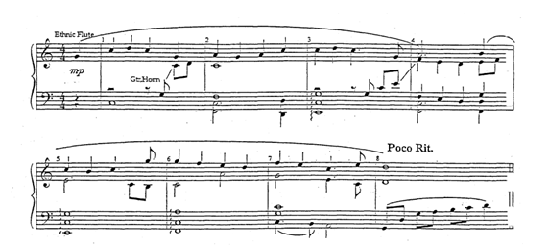
Frankly, you don't need to master staff notation to understand and play music; you can simply train your ears through listening and then play or sing creatively using Tonic Solfa. However, without formal notation, you may find yourself unable to:
- Read from sheet music: You will be limited to what you can memorize or figure out by ear.
- Understand music scales in detail: Staff notation provides a visual map of intervals and harmonic relationships that Solfa lacks.
- Communicate complex concepts: You may struggle to discuss technical ideas, such as transposition, with other musicians.
- Document your work: You would not be able to formally write down or archive your own original compositions.
- Scale your proficiency: Ultimately, your growth as a musician may be limited without the universal language of the staff.
By learning the staff, you aren't just learning "rules"—you're gaining a tool that allows you to "save" your musical ideas forever and share them with anyone in the world.
Music is a language to be sung and heard; it communicates through both lyrics and rhythm. Much like a natural language, music is best learned first by listening (ear training) and then by singing or playing an instrument. Interestingly, just as being unable to read or write does not prevent a person from communicating in their native tongue, an inability to read sheet music does not mean a person cannot sing or play an instrument. It simply limits the scalability of their skills.
Tonic Solfa is a simplified musical language—much like a musical "slang." It allows a person to quickly learn and communicate music in informal settings. However, it is octave-bound, which creates certain limitations. Formal written music is more complex; it utilizes a staff (plural: stave, staves) consisting of five horizontal lines and vertical lines. The horizontal lines represent the pitch scale for notes, while vertical lines indicate the start or end of a measure. Finally, the clef defines the specific pitch range for the entire composition.
The illustration depicts a grand stave comprising two staff joined by a brace. The brace indicates that the stave represent music played on a single instrument using two hands, with one hand on the bass end and the other on the treble end. The upper staff features the treble clef (𝄞), while the lower staff features the bass clef (𝄢). The treble clef is also known as the G-clef because its curl centers on the G note line, while the bass clef is also referred to as the F-clef because the F note line passes directly through the center of the two dots that characterize the symbol.
There are seven (7) musical alphabets representing the musical notes. They are $A$, $B$, $C$, $D$, $E$, $F$, and $G$. Unlike those of the tonic sol-fa, these alphabets represent absolute pitch levels (notes) on the clef staff.
From the illustration above, you can see the alphabets in their absolute positions on the grand stave. The upper staff is the treble staff, where the four spaces represent the pitches $F - A - C - E$. The lower staff is the bass staff and its four spaces represent the pitches $ A - C - E - G$. Additionally, there is a $middle\:C$, which belongs to a hidden alto clef whose spaces represent the pitches $G - B - D - F$.
In sheet music, note symbols are used on the staff instead of the alphabets; however, the specific line or space where a note is drawn indicates the pitch (alphabet). These note symbols also represent the rhythmic value (duration) of the pitch. There are equivalent rest symbols used to represent the same duration of silence within music. Check the table below to see the notes against their value and equivalent rests.
| Symbol | Name (US / UK) | Value (in 4/4 time) | Equivalent Rest |
|---|---|---|---|
| _semibreve_ | Whole note (Semibreve) | 4 beats | _semibreverest_ |
| _minim_ | Half note (Minim) | 2 beats | _minimrest_ |
| _crochet_ | Quarter note (Crotchet) | 1 beat | _crochetrest_ |
| _quaver_ | Eighth note (Quaver) | 1/2 beat | _quaverrest_ |
| _semiquaver_ | Sixteenth note (Semiquaver) | 1/4 beat | _semiquaverrest_ |
Below is a typical example of a note on a staff. The note on the staff is $middle\:C$.
Accidentals are symbols placed before a note to signify a slight change in pitch of the note. We have sharp (♯), flat (♭), and natural (♮) as the main accidentals. Below, you see a staff containing the middle $C\sharp$ note.
When an accidental follows a note, it affects every subsequent note of the same pitch within a single measure, effectively altering its state until a barline is reached. Note that the accidental wouldn't follow the subsequent notes affected by the initial accidental. Once the barline is crossed, the pitch automatically reverts to the state designated by the key signature, unless the note is sustained via a tie. If a tie carries the pitch into the following measure, the alteration remains valid only for the duration of that tied note, after which any subsequent occurrences of that pitch return to the state designated by the key signature. To manually revert a sharp or flat within the same measure, a natural sign is used to restore the note to its original pitch.
From the above staff, you find in the first measure/bar that the first note is explicitly marked as an $F\sharp$, which dictates that the subsequent $F$s in the same bar must also be played as $F\sharp$ due to the accidental's influence lasting until the barline. But then, the third $F$ note which is suppose to be played as $F\sharp$ would have to be played as normal or natural $F$ since the $\natural$ accidental follows it.
In the second measure, we have the third note marked as $E\flat$ and it is tied to the first note $E$ on the third measure. This implies we would have to play the $E\flat$ note into the third measure as three beats. After the first note which is a tie from the second measure/bar, other $E$ notes would be played as natural $E$ since there is no key signature on the staff.
Key Signature defines the prevailing key of the music that follows, thus avoiding the use of accidentals for many notes. If no key signature appears, the key is assumed to be C major/A minor, but can also signify a neutral key, employing individual accidentals as required for each note.
Key signature on a staff is implied by the placement of a set of sharps or flats on lines and/or spaces of the staff, after the clef, to change the default pitch of the line and/or space they are placed upon. For example, the illustration above has five (5) sharps ($\sharp$s), which implies $B \:major$ or $G\sharp \:minor$ key signatures. You can find similar matchings in the circle below. The circle is called the Circle of Fifths. We use it to find how different key signatures are represented on a staff visually.
Each key signature represents a musical scale. A musical scale is a collection of ascending or descending notes that make an octave. For example, the $A \:major$ and $F\sharp \:minor$ key signatures although having the same representation on the staff, have different musical scales.
| Key | $Do$ | $Re$ | $Mi$ | $Fa$ | $So$ | $La$ | $Ti$ |
|---|---|---|---|---|---|---|---|
| $A \:major$ | $A$ | $B$ | $C\sharp$ | $D$ | $E$ | $F\sharp$ | $G\sharp$ |
| $F\sharp \:minor$ | $F\sharp$ | $G\sharp$ | $A$ | $B$ | $C\sharp$ | $D$ | $E\sharp$ |
Other musical scales with similar key signatures are $C\:major$ and $A\:minor$, $G\:major$ and $E\:minor$, $D\:major$ and $B\:minor$, $E\:major$ and $C\sharp\:minor$, $B\:major$ and $G\sharp\:minor$, $F\sharp\:major$ and $D\sharp\:minor$, $G\flat\:major$ and $E\flat\:minor$, $D\flat\:major$ and $B\flat\:minor$, $A\flat\:major$ and $F\:minor$, $E\flat\:major$ and $C\:minor$, $B\flat\:major$ and $G\:minor$, $F\:major$ and $D\:minor$, and $C\sharp\:major$ and $C\flat\:major$.
Time signature is pair of stacked numbers that tells the number of beats per bar or measure thus hinting the kind of notes or rests that constitute the music piece. Consider the staff below:
The time signature is $3/4$ which means 3 quarter notes (_crochet_). This time signature can also contain 1 quarter note and 1 half note (_minim_) in one measure.
Let's see another staff:
The time signature is $6/8$ which means 6 eighth notes (_quaver_). You can then calculate to find the number and kinds of notes (and equivalent rests) for each measure based on the given time signature.

From the staff notation, first thing to notice is that the clef is a treble clef without a key signature. When you don't have a written key signature, then the key is either $C\:major$ or $A\:minor$. Next, we notice that the time signature is 4/4.
Next, we take note of the notes and where they are placed. In this case, we have:
C   C   G   G   | A A A A G       | F   F   E   E   |
D   D   C       | G   G G F   F   | E   E E D       |
F   F F E E E E | D   D D C       | C   C   G   G   |
A A A A G       | F   F   E   E   | D   D   C       |
To play the music, you have to notice that the music is in $C\:major$. We can say that for sure because the last note is $C$, although exceptions to this end-note rule exist but can be put at 1 in 10. Next, if your instrument is a $C$ instrument like a soprano recorder, you can play the notes just as they are, else you may either transpose to suite your instrument or tune your instrument, if tuning applies to your instrument. If played well, you should get a sound like the one below:
- Music is a language to be sung and heard, but it can be written and read by means of the staff sheet.
- Understanding to read and write music helps you scale up professionally, as you can communicate and play any music.
- A staff consist of horizontal and vertical lines. The horizontal lines represent pitch levels while the vertical lines represent the start or end of a measure/bar.
- On the staff, we find clef, key signature, time signature, notes and rests.
- Clefs defines the pitch range of the entire composition. Examples are treble clef, bass clef, alto clef, etc.
- Musical alphabets, $A, B, C, D, E, F, \text{and } G$, represent absolute pitches unlike the Tonic Solfa. The spaces on the treble clef are $F - A - C - E$, while the space on the bass clef are $A - C - E - G$.
- Common notes are whole note (semibreve, _semibreve_), half note (minim, _minim_), quarter note (crochet, _crochet_), eighth note (quaver, _quaver_), sixteenth note (semiquaver, _semiquaver_). Their corresponding rests are _semibreverest_, _minimrest_, _crochetrest_, _quaverrest_, _semiquaverrest_.
- Accidentals are placed before notes to change the pitch slightly. ♯ raises the pitch, ♭ reduces the pitch, ♮ return the changed pitch back to its natural form.
- Key signature is the collection of accidentals (sharps or flats) placed on a staff after the clef to alter natural pitch of the staff, thereby creating a musical scale.
- Time signature is the pair of stacked numbers that tells the number of beats per measure. For example: a time signature of $4/4$ hints 4 beats (_crochet_s).
- To read and play a staff, you first need to take note of the clef(s). Next, you take note of the key signature and then the time signature. Next, you take note of the note alphabets. Next, take note of the actual musical scale by observing the tonic of the music. Next, play creatively using your instrument.